
108544-01
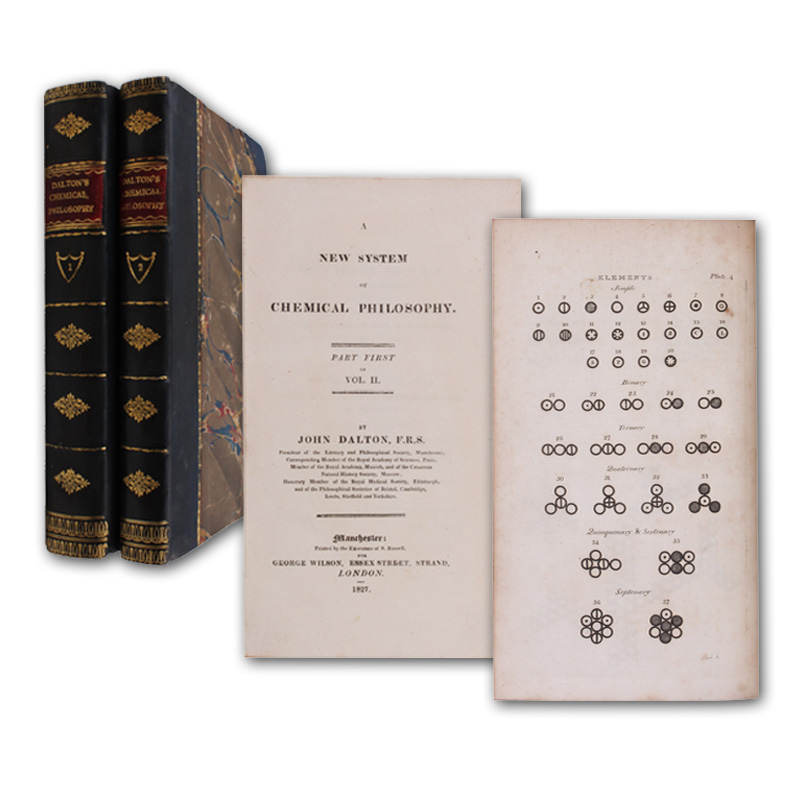
A new system of chemical philosophy. 3 Teile in 2 Bänden.
Manchester, Russell für Bickerstaff bzw. für Wilson in London, 1808-27. - (21,5 x 13 cm). VI (2) 220 S.; 4 Bll., SS. 221-560/ XII, 357 (3) S. Mit 8 lithographierten Tafeln. Halblederbände der Zeit.
Erste Ausgabe. "One of the great classics in chemistry in which the atomic theory is first established" (Duveen). - "Dalton's chemical atomic theory was the first to give significance to the relative weights of the ultimate particles of all known compounds, and to provide a quantitative explanation of the phenomena of chemical reaction. Dalton believed that all matter was composed of indestructible and indivisible atoms of various weights, each weight corresponding to one of the chemical elements, and that these atoms remained unchanged during chemical processes. Dalton's work with relative atomic weights prompted him to construct the first periodic table of the elements (in Vol. I, pt. 1), to formulate laws concerning their combination and to provide schematic representations of various possible combinations of atoms. His equation of the concepts 'atom' and 'chemical element' was of fundamental importance, as it provided the chemist with a new and enormously fruitful model of reality" (Norman). - Stellenweise leicht stockfleckig und gebräunt. Rücken und Ecken erneuert. Deckel leicht berieben. Insgesamt schönes und gut erhaltenes Exemplar. - DSB 3, 537; Partington III, 799; PMM 261; Dibner 44; Duveen 156; Horblit 22; Norman 575
A new system of chemical philosophy. 3 Teile in 2 Bänden.
Manchester, Russell für Bickerstaff bzw. für Wilson in London, 1808-27. - (21,5 x 13 cm). VI (2) 220 S.; 4 Bll., SS. 221-560/ XII, 357 (3) S. Mit 8 lithographierten Tafeln. Halblederbände der Zeit.
Erste Ausgabe. "One of the great classics in chemistry in which the atomic theory is first established" (Duveen). - "Dalton's chemical atomic theory was the first to give significance to the relative weights of the ultimate particles of all known compounds, and to provide a quantitative explanation of the phenomena of chemical reaction. Dalton believed that all matter was composed of indestructible and indivisible atoms of various weights, each weight corresponding to one of the chemical elements, and that these atoms remained unchanged during chemical processes. Dalton's work with relative atomic weights prompted him to construct the first periodic table of the elements (in Vol. I, pt. 1), to formulate laws concerning their combination and to provide schematic representations of various possible combinations of atoms. His equation of the concepts 'atom' and 'chemical element' was of fundamental importance, as it provided the chemist with a new and enormously fruitful model of reality" (Norman). - Stellenweise leicht stockfleckig und gebräunt. Rücken und Ecken erneuert. Deckel leicht berieben. Insgesamt schönes und gut erhaltenes Exemplar. - DSB 3, 537; Partington III, 799; PMM 261; Dibner 44; Duveen 156; Horblit 22; Norman 575
26.000 €