
106218-01
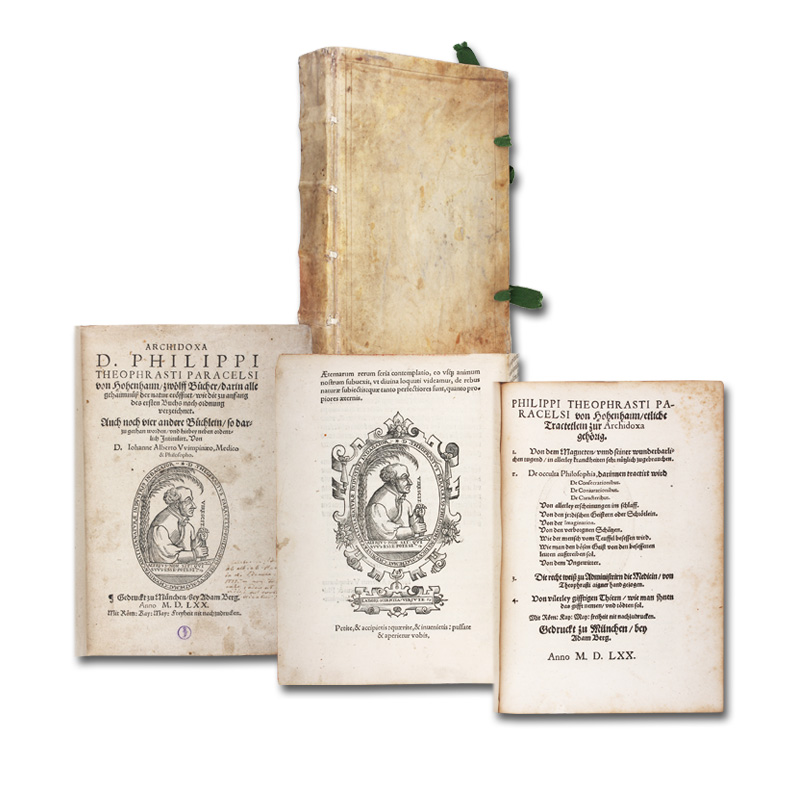
Archidoxa... zwölff Bücher, darin alle gehaimnüß der natur eröffnet... Auch noch vier andere Büchlein... Von D. Iohanne Alberto Wimpinaeo. - Beigebunden: Derselbe. Etliche Tractetlein zur Archidoxa gehörig. 1. Von dem Magneten... 2. De occulta philosophia... 3. Die recht weiß zu administrirn die Medicin... 4. Von vilerley gifftigen Thiern...
München, Berg, 1570. - (23,5 x 16 cm). 128 Bll.; 35 Bll. Erster Titel mit Porträtholzschnitt des Autors und 2 Porträtholzschnitten des Autors und Herausgebers nach Virgil Solis im Text. Zweiter Titel verso mit Porträtholzschnitt und 2 schematischen Textholzschnitten. Pergamentband der Zeit mit Bindebändern und durchzogenen Bünden.
Zu I: Titelauflage der dritten deutschen Ausgabe (dt. EA Basel 1570). - "Paracelsus's reputation as a founder of chemistry rests on his 'Archidoxa', which contains the greater part of his chemical work. Paracelsus was the first to attempt a system of chemistry; his system dealt with all chemicals known to him, and involved a classification of materials and operations. While the influence of medieval alchemy is clearly evident in Paracelsus's chemical work, it is balanced by some real advances; he attempted systematic chemical research incorporating metallurgy and pharmacology, introduced new laboratory methods, and devised new methods for rendering therapeutic chemical preparations less harmful. His chemical achievements form the link between medieval alchemy and the powerful Paracelsian movement of the 1570s that culminated in the rise of iatrochemistry in the late sixteenth and seventeenth centuries. The first edition of Paracelsus's 'Archidoxa' was published in Cracow in 1569. In 1570, six new editions appeared: two in Basel, two in Munich, and one each in Cologne and Strassburg. The present edition is a combination of Sudhoff 119... and Sudhoff 128" (Norman). - VD16 P393; Norman 1637; Sudhoff 129; Brüning 416. - Zu II: Separatausgabe des von Albert von Wimpfen herausgegebenen Anhangs zur "Archidoxa". - "This supplement to 'Archidoxa' was published both separately and together with 'Archidoxa'. This work includes tracts on the use of magnets in medicine, occult philosophy, the correct administration of medicine, and how to extract poisons from venomous animals" (Norman). - VD16 P629; Norman 1638; Sudhoff 128; Brüning 417. - Vereinzelt mit sauberen zeitgenössischen Annotationen. Vier Blätter mit kleinen Wurmspuren im äußeren weißen Rand, davon eine Stelle hinterlegt. Die ersten und letzten Blätter sorgsam gereinigt. Stellenweise gering fleckig. Buchblock neu eingehängt. Vorsätze und Bindebänder erneuert. Insgesamt gut erhalten
Archidoxa... zwölff Bücher, darin alle gehaimnüß der natur eröffnet... Auch noch vier andere Büchlein... Von D. Iohanne Alberto Wimpinaeo. - Beigebunden: Derselbe. Etliche Tractetlein zur Archidoxa gehörig. 1. Von dem Magneten... 2. De occulta philosophia... 3. Die recht weiß zu administrirn die Medicin... 4. Von vilerley gifftigen Thiern...
München, Berg, 1570. - (23,5 x 16 cm). 128 Bll.; 35 Bll. Erster Titel mit Porträtholzschnitt des Autors und 2 Porträtholzschnitten des Autors und Herausgebers nach Virgil Solis im Text. Zweiter Titel verso mit Porträtholzschnitt und 2 schematischen Textholzschnitten. Pergamentband der Zeit mit Bindebändern und durchzogenen Bünden.
Zu I: Titelauflage der dritten deutschen Ausgabe (dt. EA Basel 1570). - "Paracelsus's reputation as a founder of chemistry rests on his 'Archidoxa', which contains the greater part of his chemical work. Paracelsus was the first to attempt a system of chemistry; his system dealt with all chemicals known to him, and involved a classification of materials and operations. While the influence of medieval alchemy is clearly evident in Paracelsus's chemical work, it is balanced by some real advances; he attempted systematic chemical research incorporating metallurgy and pharmacology, introduced new laboratory methods, and devised new methods for rendering therapeutic chemical preparations less harmful. His chemical achievements form the link between medieval alchemy and the powerful Paracelsian movement of the 1570s that culminated in the rise of iatrochemistry in the late sixteenth and seventeenth centuries. The first edition of Paracelsus's 'Archidoxa' was published in Cracow in 1569. In 1570, six new editions appeared: two in Basel, two in Munich, and one each in Cologne and Strassburg. The present edition is a combination of Sudhoff 119... and Sudhoff 128" (Norman). - VD16 P393; Norman 1637; Sudhoff 129; Brüning 416. - Zu II: Separatausgabe des von Albert von Wimpfen herausgegebenen Anhangs zur "Archidoxa". - "This supplement to 'Archidoxa' was published both separately and together with 'Archidoxa'. This work includes tracts on the use of magnets in medicine, occult philosophy, the correct administration of medicine, and how to extract poisons from venomous animals" (Norman). - VD16 P629; Norman 1638; Sudhoff 128; Brüning 417. - Vereinzelt mit sauberen zeitgenössischen Annotationen. Vier Blätter mit kleinen Wurmspuren im äußeren weißen Rand, davon eine Stelle hinterlegt. Die ersten und letzten Blätter sorgsam gereinigt. Stellenweise gering fleckig. Buchblock neu eingehängt. Vorsätze und Bindebänder erneuert. Insgesamt gut erhalten
6.800 €