
117713-01
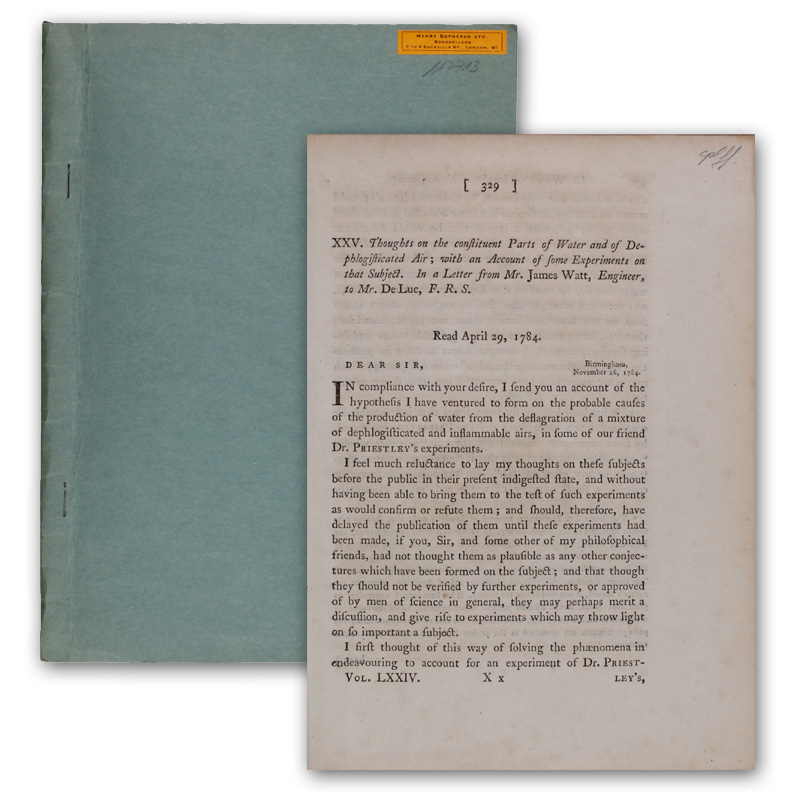
Thoughts on the constituent Parts of Water and of Dephlogisticated Air; with an Account of some Experiments on that subject. SS. 329-353. - Und: Derselbe. Sequel to the Thoughts on the constituent Parts of Water and of Dephlogisticated Air. In a subsequent Letter... to Mr. De Luc. SS. 354-357. Aus: Philosophical Transactions of the Royal Society of London. Vol. 74.
(London, 1784). - (24 x 18 cm). SS. 329-358. Moderner Kartonband.
Erste Ausgabe. - Der schottische Erfinder Watt (1736-1819), der besonders durch die Verbesserung des Wirkungsgrades der Dampfmaschine berühmt wurde, interessierte sich dadurch auch für den Dampf. Dies führte ihn zu Untersuchungen über die Natur des Wassers mit dem Ergebnis, dass er als Erster erkannte, dass Wasser kein Element sondern eine Verbindung ist und dies in vorliegender Arbeit veröffentlichte. - "Watt's career as a scientist centered on his interest in chemistry. He performed numerous experiments, was in contact with several of the foremost chemists of the day (including Black, Priestley, and Berthollet), and occasionally ventured into the realm of theory. In 1783 he formed the opinion that water is a compound; but his designation of its components was ambiguous, inasmuch as he described them as 'dephlogisticated and inflammable air, or phlogiston,' where 'phlogiston,' as he often used the term, signified various gases. During the nineteenth century a spirited debate arose among the partisans of Watt, Cavendish, and Lavoisier over credit for priority in the discovery of the 'composition of water' J.R. Partington, the historian of chemistry after closely evaluating the conflicting claims has lent his authority to the view that while Watt is entitled to credit for first stating that water is not elementary, it was Lavoisier who clearly specified what its components are" (DSB). - Wohlerhalten. - DSB 14, 196
Thoughts on the constituent Parts of Water and of Dephlogisticated Air; with an Account of some Experiments on that subject. SS. 329-353. - Und: Derselbe. Sequel to the Thoughts on the constituent Parts of Water and of Dephlogisticated Air. In a subsequent Letter... to Mr. De Luc. SS. 354-357. Aus: Philosophical Transactions of the Royal Society of London. Vol. 74.
(London, 1784). - (24 x 18 cm). SS. 329-358. Moderner Kartonband.
Erste Ausgabe. - Der schottische Erfinder Watt (1736-1819), der besonders durch die Verbesserung des Wirkungsgrades der Dampfmaschine berühmt wurde, interessierte sich dadurch auch für den Dampf. Dies führte ihn zu Untersuchungen über die Natur des Wassers mit dem Ergebnis, dass er als Erster erkannte, dass Wasser kein Element sondern eine Verbindung ist und dies in vorliegender Arbeit veröffentlichte. - "Watt's career as a scientist centered on his interest in chemistry. He performed numerous experiments, was in contact with several of the foremost chemists of the day (including Black, Priestley, and Berthollet), and occasionally ventured into the realm of theory. In 1783 he formed the opinion that water is a compound; but his designation of its components was ambiguous, inasmuch as he described them as 'dephlogisticated and inflammable air, or phlogiston,' where 'phlogiston,' as he often used the term, signified various gases. During the nineteenth century a spirited debate arose among the partisans of Watt, Cavendish, and Lavoisier over credit for priority in the discovery of the 'composition of water' J.R. Partington, the historian of chemistry after closely evaluating the conflicting claims has lent his authority to the view that while Watt is entitled to credit for first stating that water is not elementary, it was Lavoisier who clearly specified what its components are" (DSB). - Wohlerhalten. - DSB 14, 196
850 €